A therapist website should make the reason people choose you obvious. These three therapist website examples lead with the work each founder is known for: Crystal Hines’s framework, Alison Leslie’s teaching and Dana Polley’s approach to care. Each gives the people she wants to reach a clear next step.
A person looking for therapy needs to feel safe. A clinician who just watched you present needs to see the depth behind the talk. An organization planning a training needs to understand your method. When the website treats all three the same way, each of them has to work out whether they belong there.
Here is how three practices we designed handle it.
Align Therapy and Consultation: Crystal Hines leads with her framework
Crystal Hines, LPC, created IFS-Informed EMDR, a framework that teaches trauma therapists what to do when EMDR brings up a painful memory and the client shuts down or can’t move forward. She took it to the 2025 EMDRIA Conference. Her teaching with Trauma Therapist Institute and Insight Timer drew more than 1,000 registrations, and over 400 clinicians joined her live.
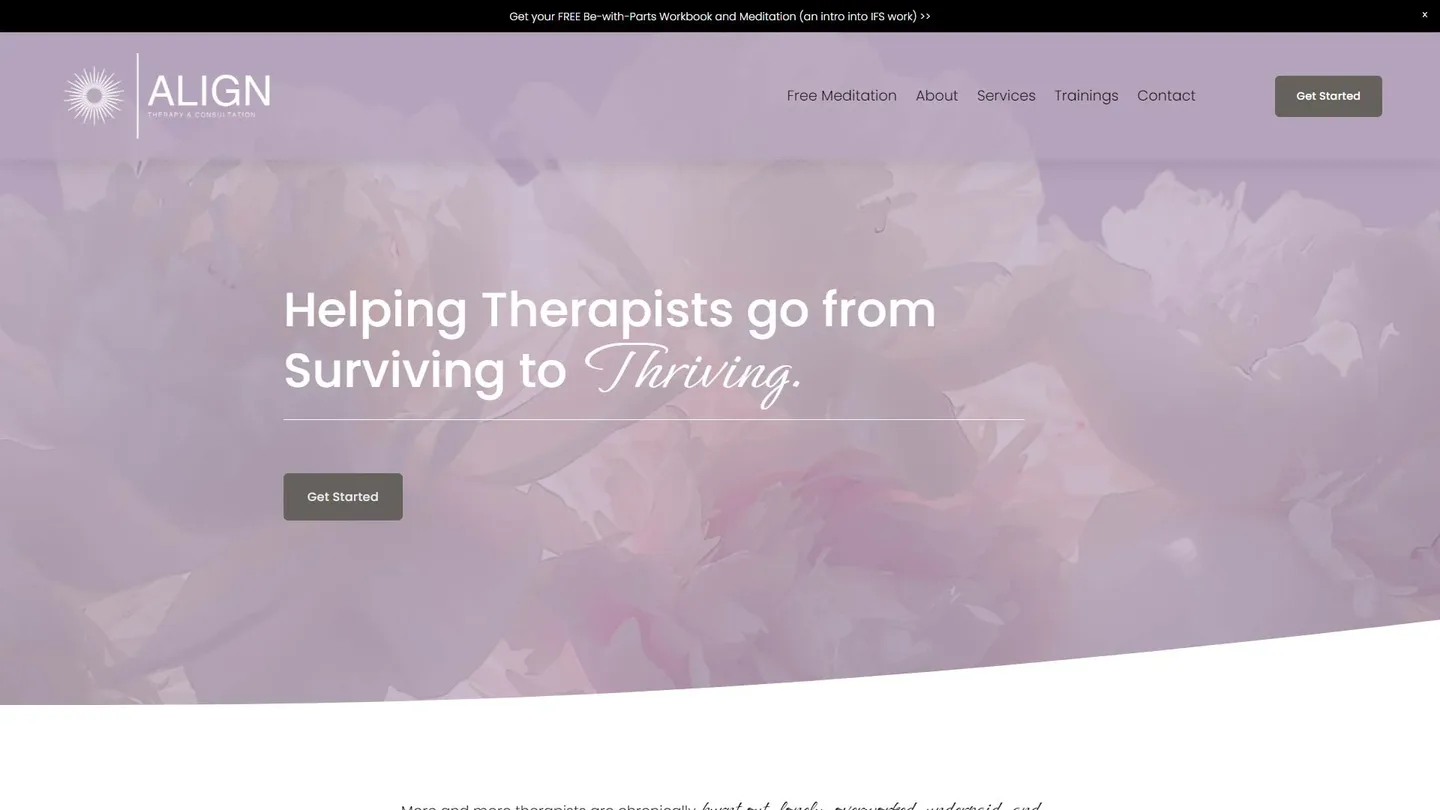
Her old Squarespace site didn’t say any of that up front. It led with “Helping Therapists go from Surviving to Thriving.” Her framework sat among the services, and her conference and teaching credentials were buried on the media page. A therapist arriving after one of her presentations had to look too hard for the reason to choose her.
We rebuilt the content and the design together. “The home of IFS-Informed EMDR” now opens the site, with her EMDRIA presentation and the demand for her teaching directly beneath it. The framework has its own page that explains the clinical problem it solves. From there, the site connects introductory learning to advanced training, certification support and consultant development, so a clinician can see how far they can go with her.

The design kept Align’s peonies, lilac and soft light and gave them more weight: oversized imagery, generous space, large type and deep plum sections for the training material.
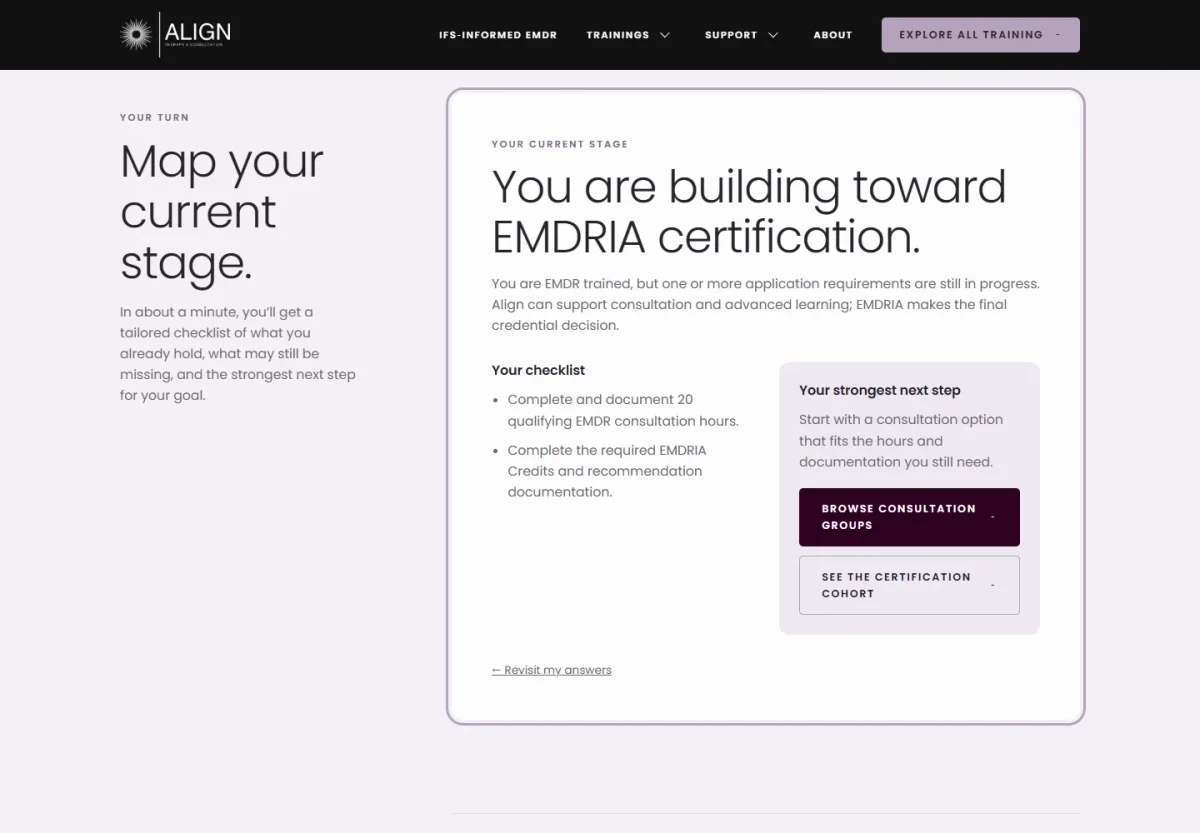
Two tools turn interest into a next step. The Training Pathway Planner turns a clinician’s qualifications and goals into a tailored checklist and a recommended next step. The Therapist Finder matches people looking for therapy with eligible members of her team by state, specialty and approach. Crystal leads with her teaching, and people seeking care still find their way in.
“Just watched the video and looked at the platform and have started sharing my new site a bit. I love all of it so much.”
Crystal Hines, LPC, founder of Align Therapy and Consultation
What to look for in your own site: if you created a method, it should be the first thing a visitor learns about you, ahead of your service list.
See the full Align Therapy case study.
Empower Healing: Alison Leslie puts her teaching first
Alison Leslie brings EMDR, somatic therapy and the human-animal bond together in trauma care, and she teaches other professionals to do the same through consultation, international presentations and training with Trauma Therapist Institute. She is an EMDRIA-approved trainer and consultant and a Somatic Experiencing Practitioner, and she contributed to the Handbook of Animal Assisted Therapy.
Her earlier homepage introduced a counseling practice and listed its modalities, with her consultation credentials further down the page. A clinician had to read past a general introduction to discover someone they could learn from.
The new opening names training and consultation right away. A section written for fellow clinicians explains how she helps them work with complex cases, deepen their skills and build confidence. Her training page gives her courses on EMDR, somatic therapy and the human-animal bond a presentation of their own, with direct paths to the organizations that offer them.

We built a custom image library around the things that run through her work: nature, animals and close attention to the body, in soft window light, purple succulents and botanical illustrations. Her own photographs keep Alison and her animals present throughout the site. People seeking therapy still have a clearly named route that leads into a brief introductory call.
Because a podcast interview lets listeners hear how she thinks, we also built her a guest packet she runs herself: bios, talk topics, ready-to-send pitch emails, 36 researched shows and a tracker for her outreach.
“Working with Diane, first on web design and then more thoroughly on brand development, was a wonderful experience. I felt heard and seen in each meeting and was able to build confidence and gain a clear path to move forward with my business objectives and goals.”
Alison Leslie, founder of Empower Healing
What to look for in your own site: if other clinicians come to you to learn, they should be able to tell within the first screen.
See the full Empower Healing case study.
River Rock Therapy: Dana Polley’s approach sets the pace
Not every therapist who wants to be seen as an authority is running trainings. Dana Polley is a licensed therapist who works with women navigating transitions in their identity, their relationships and their sense of self. Before private practice, she spent years as a school-based therapist with children and families. Her starting belief is that everything her clients are experiencing makes sense, and that they need room to understand it.
Dana describes her work with a metaphor: river rocks are shaped by gentle, steady movement over time. We made the website move the same way. Sections settle into place like water finding its level, the water at the top of the homepage ripples where your cursor touches it, and river stones, moss, sage and soft cream carry the palette.
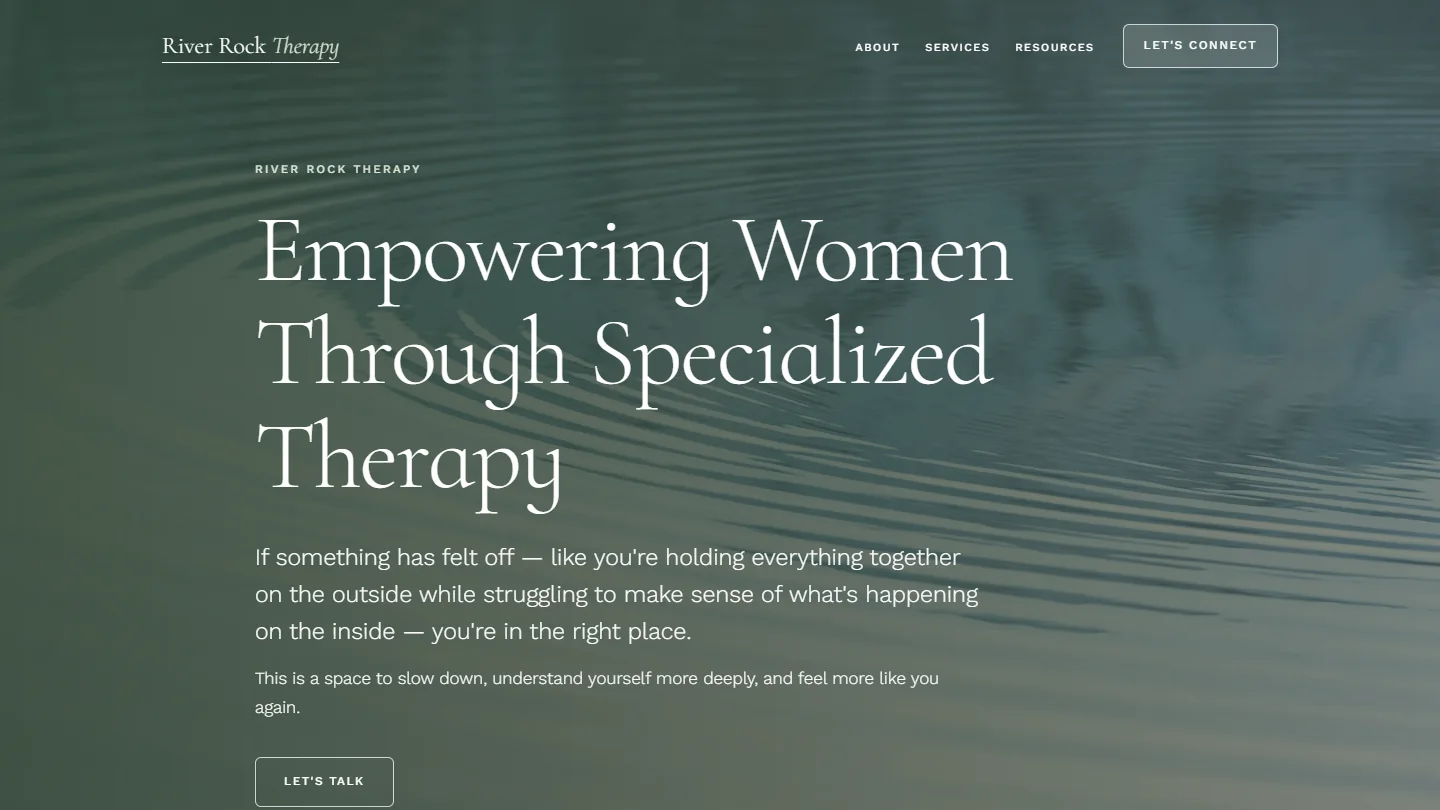
A woman who isn’t sure she needs therapy can read at her own pace. Individual therapy, groups and workshops, and Dana’s recommended resources each have a clear place, and a free consultation is one step away on every page without ever pushing. The site launched September 22, 2026 with an A and zero issues on its launch audit, and it scored 99 on mobile and 100 on desktop in Google’s PageSpeed tests.
“Oh my gosh, I love the site! Thank you so much for all your work on it!”
Dana Polley, River Rock Therapy, in an email after her website launch
What to look for in your own site: your approach should be felt in the first few seconds, before a visitor reads a single credential.
See the full River Rock Therapy case study.
What these therapist website examples have in common
None of these sites opens with a list of modalities. Each one opens with the therapist’s contribution: Crystal’s framework, Alison’s teaching, Dana’s approach. A visitor sees the authority and thought leader in her field before they see a list of services.
Align and Empower Healing give clinicians direct paths into training and consultation while keeping personal therapy easy to find. River Rock gives women room to understand Dana’s approach before they reach out. The proof follows the decision: teaching and conference work for the clinician choosing a training, and a clear account of the therapist’s approach for the person considering care.
Questions about therapist websites
What should a therapist website include if I also train other clinicians?
Give your method or teaching its own place, ideally on the homepage and on a dedicated page, with the credentials that back it up: where you’ve presented, who you’ve trained with and what you’ve published. Then give clinicians a path into your trainings or consultation, and give people seeking care a separate, clearly named route to therapy. Align and Empower Healing both work this way.
Can one website serve my therapy clients and the clinicians I teach?
Yes, as long as each visitor can tell quickly which path is theirs. On Align’s site, the Training Pathway Planner guides clinicians and the Therapist Finder guides people looking for care, so Crystal can lead with her teaching without making her therapy practice harder to find.
How do you keep a therapist website ethical?
The calls to action respect clinical boundaries and the claims stay careful. On Align’s site, for example, the program assistant answers only from Align’s published pages, declines anything that would be therapy, coaching or diagnosis, and keeps no conversation logs. The contact form includes a note that keeps clinical details out of it.
How much does a therapist website cost with Sway Rise Creative?
A Spotlight Site, a custom three-page website for one offer, starts at $2,500. Our custom website for your practice starts at $4,500, built around the brand you already have. If your positioning, brand and imagery need the work too, the full Authority Platform build is $8,500, fixed, and covers the strategy, Brand Document, Visual Brand Guide, imagery, a seven-page website, a lead tool, launch and two weeks of support. Hosting starts at $47 a month.
How long does a therapist website take?
The Authority Platform launches 30 days after kickoff.
Can you move my practice off Squarespace or WordPress?
Yes. Align Therapy and Consultation moved off Squarespace, and we rebuilt both the content and the design so Crystal’s framework leads the site. If you aren’t sure whether your current site needs a rebuild, a Website Audit for your practice is $500 and gives you a short list of fixes in order of impact.
Your expertise already reaches beyond the therapy room
If clinicians seek you out, organizations invite you to teach, or your approach is the reason clients choose you, your website should make that obvious to everyone who lands on it. See more of our website design for therapists, or tell us about your practice and we’ll tell you what your site needs to present you as the authority you already are.